A specification is only as strong as its ability to withstand procurement scrutiny and value engineering pressures.
When a façade decision reaches technical design or RIBA Stage 4, the capital cost line on the cost plan is invariably the first target for reduction. When a QS evaluates vitreous enamel against painted aluminium or HPL on an installed rate per square metre, vitreous enamel will always present a higher initial price point. Yet, if the conversation stops at capital cost and ignores the substantial performance benefits of the system, the specification is almost certain to be value-engineered out. Yet this is a short-sighted approach.
For the asset types to which vitreous enamel is genuinely suited, those characterised by long lifespans, high occupancy, super-heavy-duty performance, heavy cleaning burdens, or restricted maintenance access, the lifecycle economics completely reverse the narrative. The question is not whether vitreous enamel costs more upfront; it is whether the project can afford to reclad twice within the period that vitreous enamel remains entirely untouched.
This article provides specifiers and QS teams with the framework, the data, and the references required to robustly defend that position to procurement.
Table of Contents
What lifecycle cost effectiveness actually means
Lifecycle costing, often referred to as whole-life costing, captures the total cost of an asset ownership over its entire service life. For a façade or internal cladding, this expenditure is broadly split into four key areas:
- Capital cost: total material costing, transport and site logistics, completed installation.
- Maintenance cost: routine cleaning, periodic recoating or refinishing, repair of damage, access costs (MEWP, abseil, scaffolding).
- Replacement cost: the full re-cladding cost when the original system reaches its end-of-life service, including strip-out and disposal of the depleted system.
- Disposal cost: end-of-life waste handling, recyclability credits, embodied carbon liability.
The Royal Institution of Chartered Surveyors (RICS) and the Building Cost Information Service (BCIS) publish standardised methodologies for this precise analysis, most notably the RICS Life Cycle Costing professional standard, which aligns with BS ISO 15686-5. Furthermore, BREEAM Mat 01/Mat 03 and the RICS Whole Life Carbon Assessment (WLCA) standard now mandate mirroring this lifecycle approach on the carbon side.
A lifecycle cost case built upon these recognized frameworks is far from a subjective marketing argument; it is a procurement-grade, auditable calculation that QS teams are duty-bound to recognise and accept.
The key financial move lies in selecting the right appraisal period, typically 30 or 60 years for commercial façade assessments. A 60-year horizon is the ideal benchmark for vitreous enamel cladding. It provides the exact runway needed to lay bare the replacement-cycle disadvantage of cheaper materials, while remaining firmly within standard, non-speculative cost-modelling parameters.
Why vitreous enamel suits lifecycle analysis
Vitreous enamel is one of the few façade materials whose value case genuinely strengthens over time rather than weakens. Three material properties drive this point:
A service life of 60 years. Vitreous enamel is glass fused to steel at approximately 800°C. The finish doesn’t degrade under UV, doesn’t chalk, doesn’t fade, and doesn’t require recoating. Manufacturer test evidence under BS EN ISO 28722 demonstrates colour and gloss retention well beyond the 20-30 year service life typical of painted aluminium and HPL systems.
Specific BS EN ISO 28722 test results from Dynamic Cladding systems are available on request. Request Technical Documentation
Near-zero scheduled maintenance: The operational cleaning regime is essentially a non-chemical wash. There is no requirement for a cyclical silicone or joint sealant replacement strategy, no costly polyester powder coating (PPC) recoating cycle at years 15–20, and no risk of laminate delamination or edge-failure remediation. Furthermore, graffiti removal is entirely straightforward; because the glass-fused surface is completely non-porous and chemically inert, harsh solvents can be used repeatedly without compromising the integrity or finish of the façade.
A1 to EN13501-1 reaction-to-fire classification: Fused from steel and glass, vitreous enamel is inherently non-combustible by composition, rather than by chemical treatment. From a whole-life cost perspective, this eliminates an entire category of regulatory risk, the exact legislative exposure that necessitated the post-Grenfell remediation programmes and turned lesser-grade systems into stranded assets overnight.
These properties do not make vitreous enamel the default solution for every project. However, they firmly establish it as a material whose multi-decade cost profile deserves an honest, rigorous calculation, rather than a premature dismissal at the initial capital cost line.
The procurement challenge
Most façade specifications lose to value engineering at the same point: the QS produces a per-square-metre comparison, vitreous enamel sits 20–40% above the cheapest alternative, and the specifier hasn’t pre-built the lifecycle defence. The numbers in the next section are designed to fix that.
Capital cost: where vitreous enamel sits in the market
A like-for-like installed cost comparison on a typical UK rainscreen project, mid-2026, looks roughly like this on a £/m² basis (supply and install, including substructure and fixings, excluding scaffold and design fees):
| Material | Installed cost £/m² | Notes |
|---|---|---|
| HPL (high-pressure laminate) | £180–£280 | Standard rainscreen grade |
| Painted aluminium (PPC) | £220–£320 | 3mm solid, PPC finish |
| ACM (A2-rated) | £240–£340 | Post-Grenfell compliant grades only |
| Vitreous enamel on steel | £265- £300 | DynaPanel vitreous enamel installed |
| Natural stone (granite, limestone) | £450–£750+ | Honed/flamed finish, mechanical fix |
| Terracotta rainscreen | £350–£500 | Extruded, mechanical fix |
Source: BCIS rates, manufacturer-published indicative pricing, and live UK tender data 2024–2026. Project-specific costs will vary with panel size, finish complexity, substructure, and geometry.
Vitreous enamel typically sits between painted aluminium and natural stone on capital cost. The slight premium over PPC aluminium is real and shouldn’t be hidden in the case to procurement, it should be acknowledged. The attributes of Vitreous Enamel should be highlighted to the investor, contractor and QS team over a life-cycle cost performance, this is where the picture changes.
Maintenance cost over 40 years
This section establishes the core business case. Annual maintenance for façade and cladding systems is broadly categorized into routine cleaning, periodic refurbishment (recoating, resealing, and panel replacement), and specialized access costs. Based on published industry benchmarks and RICS-referenced lifecycle studies, the indicative annual maintenance burden per square meter (m2) over a 40-year operational period is structured as follows:
| Material | Routine clean £/m²/yr | Periodic refurb cycle | 40-yr maintenance £/m² |
|---|---|---|---|
| Material | Routine clean £/m²/yr | Periodic refurb cycle | 40-yr maintenance £/m² |
| HPL | £2–£4 | Edge sealing yr 10, 20, 30; partial replacement yr 20–25 | £180–£280 |
| Painted aluminium (PPC) | £2–£4 | PPC recoat yr 15–20, second recoat yr 30 | £160–£240 |
| ACM (A2) | £2–£4 | Sealant replacement yr 15, 30; coating refresh yr 20 | £170–£260 |
| Vitreous enamel | £1.50–£3 | None scheduled; spot panel replacement only | £60–£120 |
| Natural stone | £3–£6 | Repointing yr 20, 30; cleaning specialist | £200–£320 |
| Terracotta | £2–£4 | Joint maintenance yr 15, 30 | £140–£220 |
Indicative ranges based on RICS Life Cycle Costing methodology, BCIS maintenance datasets, and published façade lifecycle studies.
Vitreous enamel offers a substantially lower maintenance profile because it requires neither finish recoating nor substrate resealing. It completely eliminates common lifecycle liabilities, including the Year-15 PPC refresh, the Year-20 edge-seal replacement typical of laminates, and Year-30 repointing cycles. Additionally, its non-porous surface releases dirt & soling with water alone, lowering the operational cost of each cleaning cycle.
Replacement cycles: the line that decides the case
A 40-year study period exposes the replacement-cycle disadvantage of shorter-life systems. Typical service lives, drawn from manufacturer warranties, BBA or ETA certificates, and published in-service performance studies:
- HPL: 25–30 years (one full replacement within 40-year window)
- Painted aluminium: 25–35 years (likely one replacement, depending on the environment)
- ACM (A2): 30–40 years (replacement at or near the end of study period)
- Vitreous enamel: 40–60 years (no replacement within a 40-year window)
- Natural stone: 60–100+ years (no replacement)
- Terracotta: 50–75 years (no replacement)
A full façade re-clad between Year 25 and 30 cannot be classified as a standard maintenance event. Rather, it represents a major capital intervention encompassing strip-out, material disposal, specialized access logistics, professional design fees, and severe operational disruption. Industry benchmarks indicate that when these associated “soft costs” are fully loaded, a full re-clad incurs approximately 110% to 130% of the original installation cost, even before quantifying the financial impact of building-in-use disruption.
Worked example: 40-year whole-life cost per m²
A 1,000 m² façade, 40-year study period, central UK location, undiscounted:
| Cost line | HPL | Painted Aluminium | Dynamic Cladding Vitreous Enamel |
|---|---|---|---|
| Capital cost | £230 | £270 | £300 |
| 40-yr maintenance | £230 | £200 | £90 |
| Replacement at yr 27 (incl. strip-out) | £290 | £335 | £0 |
| End-of-life disposal | £15 | £10 | £8 |
| 40-yr total £/m² | £765 | £815 | £398 |
Worked example — undiscounted, mid-range figures, illustrative. A discounted NPV calculation using HM Treasury Green Book rates (3.5%) tightens the gap somewhat but does not reverse the conclusion on long-life buildings.
If Dynamic Cladding’s Vitreous Enamel is installed at a capital cost in the £265–£300 /m² range, vitreous enamel comes out 48–56% lower on whole-life cost than the cheaper-upfront alternatives, even before embodied carbon and zero building-in-use disruption costs are added.
That’s the number to put in front of the investor and procurement.
Where vitreous enamel earns its lifecycle premium
The 40-year cost case doesn’t apply equally to every project. On a 25-year design-life retail unit with easy ground-level access and no fire risk classification pressure, painted aluminium is probably the right answer. Vitreous enamel earns its place on a specific class of building and on those buildings, it earns it convincingly.
Long-life public buildings.

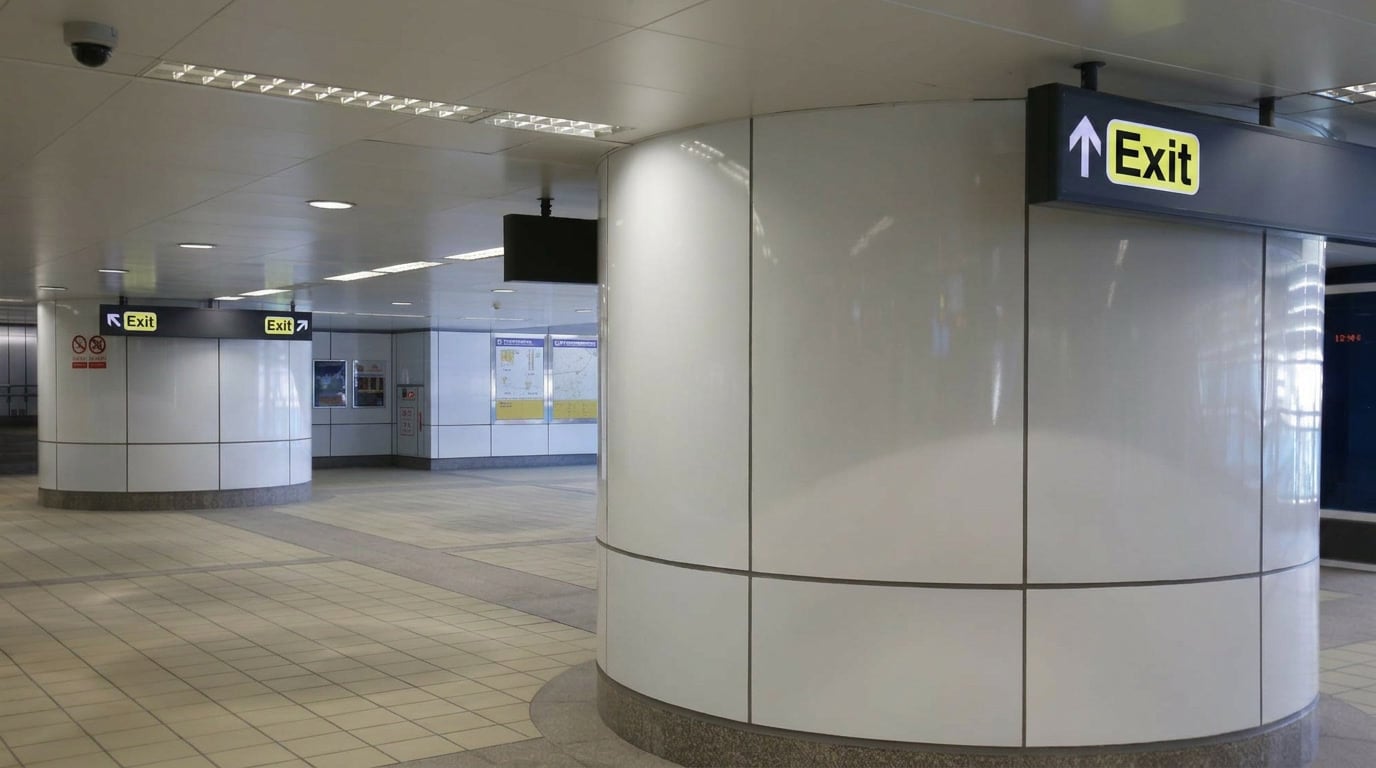
Transit infrastructure, healthcare estates, education, civic buildings, and public realm projects routinely run on 60-year design lives or longer. A railway station built today is expected to operate beyond 2086. On that horizon, a 25-year-life cladding system means two full re-clads — funded from public capital budgets, with associated programme disruption to a live operational asset. Vitreous enamel runs the period without intervention. The case for vitreous enamel on railway stations is one of the clearest in the UK market for this reason; the same logic carries to airports, hospitals, schools, and civic buildings funded through long-term public capital programmes.
High-Burden Environments
In high-pollution environments, such as urban centres, transit hubs, and coastal sites, cleaning frequencies spike across all façade and internal cladding materials. This is where the operational efficiency of vitreous enamel becomes a major financial differentiator. Its non-porous surface sheds traffic film, salt crusting, and graffiti with water alone, whereas laminates and coated systems require intensive detergent washes that steadily degrade their finishes. Over a 40-year horizon, the compounded cleaning cost differential in these harsh environments can easily surpass the system’s upfront capital premium.
Logistical Constraints & Access Overhead
High-rise facades, historically listed building envelopes, atria, and structures cantilevered over the public realm or operational infrastructure carry access logistics that heavily eclipse the cost of the physical work performed. In central London, a Mobile Elevating Work Platform (MEWP) daily rate for high-level access routinely exceeds £1,500, while industrial rope-access (abseil) teams on high-rise assets command a significant premium. Consequently, any specification that mandates a mid-life capital intervention, such as a Year-15 polyester powder coating (PPC) remediation or a Year-20 joint sealant replacement on a 30-story tower, introduces severe hidden liabilities. These overheads are routinely omitted from nominal per-square-meter (m2) maintenance tables, yet they ultimately dictate the actual procurement decision. Vitreous enamel mitigates this risk by completely removing scheduled structural or cosmetic access cycles.
Net Zero and embodied carbon
The carbon case is increasingly the procurement case. RICS Whole Life Carbon Assessment methodology and BREEAM Mat 03 both require modules A1–A5 (product and construction), B1–B7 (in-use), and C1–C4 (end-of-life) to be calculated across the building’s reference study period.
A façade replaced once at year 27 carries the embodied carbon of two installations — A1–A5 paid twice. On a 40-year study period, that doubling is not theoretical; it appears directly in the WLCA result and the BREEAM credit count. Avoiding the recladding cycle is one of the most effective material decarbonisation strategies available on the façade application, alongside the broader principles covered in sustainable rainscreen cladding.
The post-Grenfell remediation program transformed regulatory compliance from a secondary consideration into a hard commercial reality that the industry continues to navigate. Buildings wrapped in non-compliant composite systems are currently being stripped and re-clad at full capital expense, effectively forcing developers to write off the asset’s original financial investment and embodied carbon footprint. The inherent Class A1 non-combustible fire rating that vitreous enamel carries by composition (covered in detail in fire and blast resistant cladding) is more than a baseline safety benchmark. It serves as a permanent hedge against future regulatory interventions, insulating the asset from code-enforced replacement risks over its entire 60-year horizon.
Capital Cost Parity in Premium Specifications
For projects specifying natural stone equivalents, transport hubs, civic institutions, premium commercial frontages, or high-traffic public realms, vitreous enamel frequently delivers an immediate capital cost advantage. It routinely undercuts natural stone and alternative high-end materials on an installed basis, while providing matching visual permanence and an extended service life on a like-for-like maintenance scale. The primary trade-off rests within its aesthetic range: vitreous enamel is a manufactured system and cannot replicate the organic, geological variations inherent to natural stone, a distinction specifiers seeking a purely lithic appearance must evaluate upfront. However, where the architectural brief mandates absolute colour permanence, decades of surface integrity, and complete immunity to environmental staining or biological growth, vitreous enamel competes directly on initial capital expenditure while commanding total dominance on a whole-life basis.
The honest limits of the case
Vitreous enamel carries a slight uplift in capital cost over PPC aluminium, HPL and through colour cement board applications, Vitreous Enamel’s case is built on lifecycle, not upfront cost. The finish range, while broad, doesn’t extend to natural stones, naturally occurring variations.
A buyer-journey article that hides these isn’t credible. A specifier defending the spec to procurement needs to walk into the room having already conceded what’s worth conceding, so the lifecycle numbers carry the argument.
How to present the lifecycle case to investors, procurement and QS teams
A specifier who walks into a value engineering meeting with a glossy product brochure loses. A specifier who walks in with a one-page whole-life cost comparison referencing RICS methodology, BCIS rates, and a manufacturer EPD usually wins. The framing matters as much as the numbers.
Three principles hold up consistently in practice.
Lead with the study period, not the material.
The first question to settle in the room is: what design life is this building specified to? If the answer is 40 or 60 years, the conversation is no longer about cheapest-on-day-one. It’s about cheapest-over-the-period — and that’s a question the QS is professionally trained to answer using lifecycle methodology, not capital cost benchmarking.
Concede the capital premium openly.
Address the capital premium directly. Specifiers who position vitreous enamel as the cheapest option on day one risk losing credibility where it matters most. The honest, most effective commercial framing should be straightforward: accept that the upfront capital cost sits X % higher than PPC aluminium, demonstrate the compounded 40-year operational and replacement savings, and show the optimized net position. Procurement teams respect transparency; they trust specifiers who concede upfront costs to prove long-term value.
Quantify what’s normally left vague.
“Lower maintenance” is a marketing claim. “£90/m² maintenance over 40 years versus £200/m² for the PPC alternative, sourced from BCIS” is a procurement document. The shift from adjective to number is what moves the conversation.
The reference framework
A defensible lifecycle case rests on four published frameworks that QS teams already accept:
RICS Life Cycle Costing professional statement, aligned with BS ISO 15686-5. This is the methodological backbone, it defines how to calculate capital, maintenance, replacement, and disposal costs over a defined study period, with appropriate discounting.
BCIS maintenance and life cycle datasets. Industry-standard cost benchmarks for cleaning, refurbishment, and replacement activities across material categories. QS teams use BCIS routinely; numbers sourced from BCIS don’t require defending.
RICS Whole Life Carbon Assessment and BREEAM Mat 03. The carbon equivalents of the cost case are increasingly required at planning and procurement stages on public sector and ESG-disclosing private projects.
Manufacturer test evidence. BS EN ISO 28722 and ISO 28765 for vitreous enamel performance. These are the supporting evidence that converts a methodological framework into a project-specific case.
Procurement objections and how to answer them
“Capital cost is too high.”
Reframe the statement to a whole-life cost over the building’s design life, referencing RICS LCC methodology. Show the worked example.
“How do we know the service life claim is real?”
ISO 28722 and ISO 28765 test results. Tested vitreous enamel systems have been in use on UK public buildings, underground stations, hospitals and schools, since the 1960s. The evidence is fifty years of installed materials on buildings, not a manufacturer datasheet.
“What if the building gets re-purposed before year 40?”
Vitreous enamel retains residual service life and resale value better than systems approaching end-of-life. A 20-year-old VE façade has 20–40 years of service life remaining; a 20-year-old PPC system is approaching its first major recoat.
“We don’t have lifecycle data in our cost plan template.
“ RICS publishes the methodology; BCIS publishes the rates. The data exists. The question is whether the project has the budget framing to use it.
Accessing Dynamic Cladding’s lifecycle data
Dynamic Cladding supports whole-life cost modelling, providing test evidence for DynaPanel vitreous enamel on request. The technical evidence pack is project-specific built around the panel format, finish, fixing system, and environment of the actual specification, rather than generic marketing materials.
Specifiers building a lifecycle case for procurement can request our technical support at any project stage. We are more than happy to support with feasibility comparisons.
Need a lifecycle cost analysis for your project?
Request Dynamic Cladding’s whole-life cost model and test evidence pack — tailored to your specification. Request Technical Documentation
Building a value engineering case for vitreous enamel?
Book a specification consultation — Dynamic Cladding’s technical team can support cost defence to procurement and QS teams. Book a Specification Consultation