Exterior wall finishes are critical not only for visual appeal but also for performance and sustainability. According to the World Business Council for Sustainable Development, the building façade, or “skin”, can contribute up to 15% of a commercial building’s upfront embodied carbon.
This guide compares key exterior wall finish types, such as masonry, EIFS, glass, stone, and composite panels, helping you choose materials that balance aesthetics, durability, fire safety, and environmental impact.
Table of Contents
Importance of Choosing the Right Exterior Wall Finish
The exterior wall finish acts as both a protective envelope and a design-defining element. It shields the structure from wind-driven rain and UV degradation, and its thermal properties can influence HVAC loads. High-performance finishes also play a role in fire safety compliance, particularly under UK regulations such as EN13501-1.
In addition to aesthetics and functionality, the right finish ensures compliance with local building regulations. This is particularly important in the UK, where fire safety standards are stringent.
Selection should balance regulatory compliance, structural feasibility, and the architectural vision, while factoring in lifecycle maintenance demands and sustainability credentials.
Types of Exterior Wall Finishes and Materials
Masonry Finishes
Masonry finishes (brick, stone, concrete) deliver:
- Thermal conductivity: 0.6–1.4 W/m·K²
- Weight: 150–200 kg/m²
- Installation cost: £70–£120 / m²
- Maintenance interval: Repointing every 15 years
Masonry systems are suitable for low- to mid-rise buildings where thermal mass and historic character are priorities. However, their weight and substructure demands make them less feasible for retrofits or lightweight framing.
The installation of masonry finishes can be labour-intensive and costly. Without proper maintenance, including repointing and surface treatments, masonry façades risk efflorescence, water ingress, and thermal bridging that can compromise energy performance.
Stucco and EIFS (Exterior Insulation and Finish Systems)
Traditional Stucco is cementitious and moisture-permeable, commonly used in warmer, drier climates. EIFS incorporates insulation boards and synthetic coatings, achieving U-values as low as 0.28 W/m²·K, ideal for energy-efficient upgrades in temperate or urban climates.
With U-values down to 0.28 W/m²·K and weight under 15 kg/m², EIFS suits retrofits and lightweight structures. Custom RAL colour and texture options allow integration into varied architectural schemes, from schools to multi-residential blocks.
Poor detailing at joints and flashing areas can lead to moisture entrapment and system failure. Use only certified EIFS installers and ensure periodic façade checks every 2–3 years.
Glass and Ceramic Coated Panels
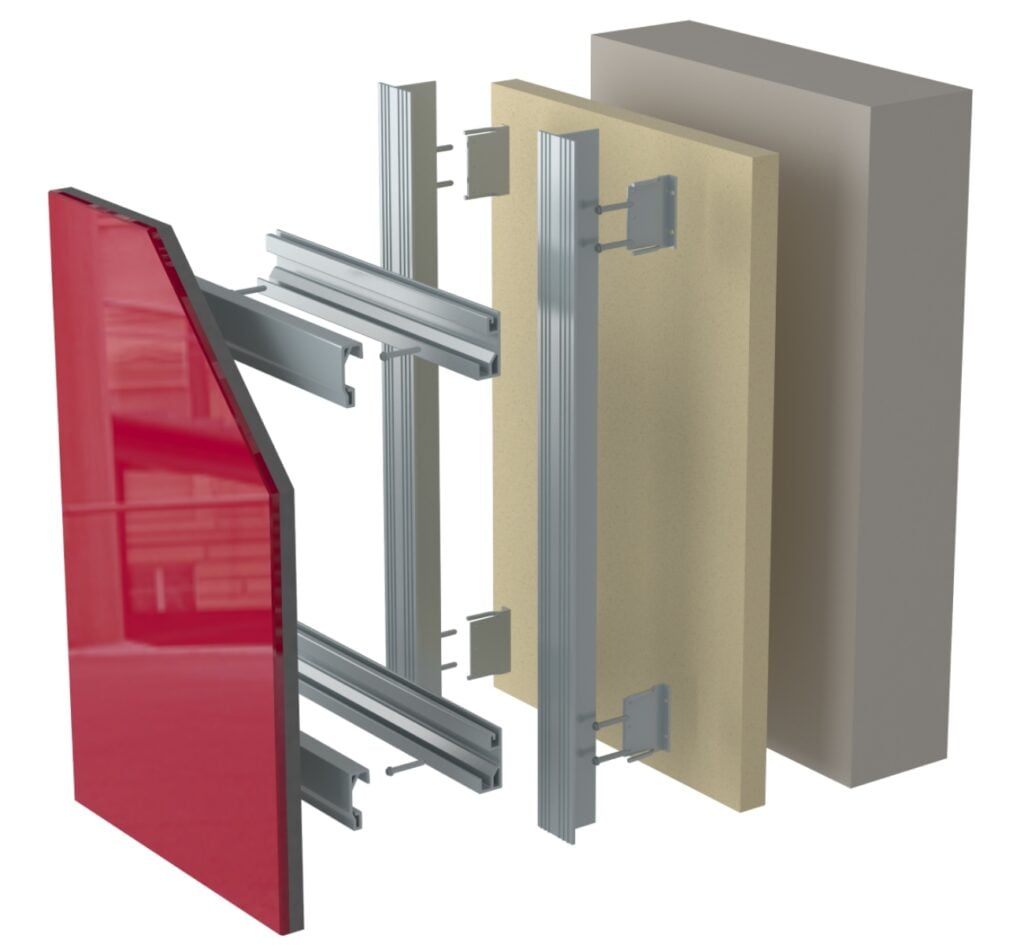
DynaPanel Glass utilises a proprietary ceramic-laminated glazing process, producing 24-26 mm-thick panels certified A1 non-combustible, ideal for high-rise and transport infrastructure.
Third-party tests confirm a 50-year service life in coastal environments, with custom digital imagery options on demand.
With an A1 non-combustible rating, these panels are ideal for high-rise buildings and areas with strict fire safety regulations. They offer versatile appearance options, including RAL colours and custom digital imagery.
These panels suit façades where precision alignment, high reflectivity, and safety compliance converge, such as airports, hospitals, or corporate HQs requiring durable, low-maintenance exteriors.
Natural Stone Finishes

Natural stone (marble, granite, limestone, travertine) delivers:
- Weight: Traditional stone ~80 kg/m² vs DynaPanel Stone at 40 kg/m²
- Fire Rating: A2 s1 d0 (EN 13501-1)
- Typical cost: £90–£150 / m²
While traditional stone cladding is heavy and expensive, lightweight alternatives like DynaPanel Stone provide the same aesthetic appeal without the structural load. These panels are up to 50% lighter and comply with fire safety regulations (A2 s1 d0) to EN 13501-1.
Stone finishes are typically specified for premium-grade commercial or civic buildings, especially where longevity and high-end aesthetics are priorities. In interiors, lightweight stone panels can serve as moisture-resistant, visually striking feature walls in lobbies and atria.
Vitreous Enamel Cladding Panels

Vitreous enamel, a fused glass coating on metal, offers exceptional resistance to chemicals, graffiti, and abrasion. Its vivid, colour-stable surface makes it ideal for high-traffic environments and long-lifespan architectural branding.
These panels can be customised with digital or screen-printed graphics, making them ideal for signage and branding. They are also non-combustible, with an A1 fire rating.
Vitreous enamel panels are suitable for projects that require a combination of durability and aesthetic appeal. They are commonly used in public infrastructure and commercial buildings.
Timber and Composite Finishes
Timber offers biophilic design benefits but demands intensive upkeep. Composite wood substitutes, made from recycled polymers and fibres, provide dimensional stability, UV resistance, and ease of installation, ideal for multi-unit residential façades.
Genuine timber requires regular maintenance to prevent rot and insect damage. Composites, on the other hand, are resistant to these issues but may lack the authentic look of real wood.
Sustainability Scorecard:
| Material | Embodied CO₂ (kg CO₂e/m²) | Recyclability % | Service Life (yrs) | Maintenance |
| Engineered wood | 12 | 85 | 25 | Clean & inspect annually |
| Fibre cement siding | 14 | 60 | 30 | Repaint every 10 years |
| DynaPanel Vitreous | 8 | 95 | 50 | Wipe clean as needed |
Metal and Aluminium Claddings
Metal cladding systems, ranging from pre-weathered zinc to powder-coated aluminium and corten steel, offer diverse aesthetic effects and strong weather resistance. Aluminium’s corrosion resistance makes it ideal for coastal areas, while copper and corten provide natural patina effects for expressive façades.
Aluminium panels (typically 8–10 kg/m²) are favoured in marine zones and tall structures due to their high strength-to-weight ratio. Steel and copper are often specified in civic or commercial projects where visual character and structural strength are paramount.
When selecting metal claddings, consider the project’s location and environmental conditions. Proper installation and maintenance are crucial to prevent corrosion and ensure longevity.
Key Takeaway: Aluminium panels weigh just 8–10 kg/m², resist corrosion in coastal zones, and carry a B-S1-d0 fire rating, ideal for seaside hotels or marine-facing façades.
Fibre Cement and Engineered Wood
Fibre cement panels replicate the look of timber while resisting fire, insects, and rot. Engineered wood, often made from bonded wood strands, provides improved stability and reduced waste, supporting sustainable design goals with a natural finish.
Fibre cement is resistant to rot, fire, and insects, making it a popular choice for residential and commercial projects. Despite its benefits, fibre cement is brittle and requires expert cutting and sealing. Poor detailing or gaps in installation can allow moisture ingress, leading to delamination or mould behind the cladding.
Engineered wood panels offer a more sustainable alternative to traditional wood. They are often used in projects that require a natural look with reduced environmental impact.
Selecting the Right Exterior Wall Finish
Factors to Consider in Material Selection
Material selection should begin with a climate-performance match: UV resistance for southern exposures, corrosion resistance for coastal zones, and freeze-thaw durability for cold regions. The fire classification, panel weight, and design flexibility should be based on project constraints.
Weight implications and structural considerations are also important. Lightweight materials can reduce the load on the building’s structure, making them ideal for high-rise projects.
Aesthetic preferences and customisation needs should align with the building’s design and the owner’s vision. Consider finishes that offer a range of colours and textures for greater flexibility.
Compliance with UK building regulations and fire safety standards (EN13501-1) is crucial. Ensure the chosen material meets the necessary requirements for safety and performance.
Cost and Long-Term Maintenance Requirements
Evaluate both CapEx (e.g., £50–£150/m² for cladding materials) and OpEx (maintenance intervals, repainting, sealant renewal). A lifecycle cost model helps determine whether upfront savings offset long-term servicing, especially in commercial projects with 30–50-year timelines.
For instance, DynaPanel Vitreous requires only periodic surface wiping, whereas engineered wood needs yearly inspection and fibre cement demands repainting every decade. Establishing a maintenance schedule early reduces lifecycle surprises.
Advanced Safety and Security Considerations for Exterior Finishes
Fire Safety and Compliance
UK building regulations mandate A1 or A2-s1,d0 fire ratings for high-rise and certain public-use buildings. Non-combustible materials such as mineral-fibre composites and ceramic-coated glass provide compliance without sacrificing aesthetics.
A1-rated materials do not contribute to fire at all, while A2-s1,d0 allows minimal smoke and no flaming droplets, both meeting UK Approved Document B for façades over 18 metres.
Dynamic Cladding is committed to providing fire-safe façade materials that meet the highest safety standards. Their products are designed to ensure safety and compliance.
Explosion Protection and Security Panels
Panels tested under ISO 16933:2007 must withstand blast overpressure without shattering. DynaPanel’s blast-resistant systems use laminated cores and concealed fixings to contain debris, ideal for transit hubs and government buildings.
Certification standards, such as ISO 16933:2007, ensure the panels meet the required safety and performance criteria. These solutions are ideal for infrastructure, government buildings, and critical facilities.
Installation Overview and Best Practices
1. Pre-Installation Checklist
- Substrate inspection: Verify flatness tolerance of ±3 mm over a 2 m straight-edge and confirm substrate moisture < 5 % RH using a Protimeter.
- Drainage plane & ventilation: Install a 20 mm ventilated cavity with vertical aluminium Z-profiles at 600 mm centres, ensuring weep-holes every 900 mm at the base.
- Fixings & brackets: Use 304 stainless-steel torsion-spring brackets rated to 2 kN; position at rail-head every 450 mm vertically and 600 mm horizontally.
- Sealants & flashings: Fit double-bead silicone seals (BS 5889 Class 25LM) at all joints and apply drip-edge flashings above window heads.
2. Step-by-Step Installation
- Install rail framework: Secure Z-profiles to substrate with stainless-steel anchors, checking plumb after every three brackets.
- Place drainage membrane: Clip in a breather membrane (e.g. Tyvek UV Façade) behind rails, overlapping by 150 mm and taping all laps.
- Mount panels: Engage panel hooks into rail slots, then tighten torsion springs to 1.2 kN. Verify panel alignment within ±1 mm.
- Seal & flash: Apply back-butt silicone at all horizontal joints and fit perimeter flashings with a minimum 50 mm overlap.
- Quality sign-off: Conduct a water-spray test at 5 kPa for 15 minutes; log results in the QA register under project code DCP-INST-2025.
3. Avoiding Common Pitfalls
- Moisture ingress: A recent London apartment block failed when installers omitted cavity weep-holes; ensure weep-hole spacing ≤ 900 mm.
- Bracket failure: Inadequate load-testing led to panel drops in a Manchester office façade; always load-test each bracket assembly to 2.5 kN before panel fit.
Emerging Trends in Exterior Wall Finishes
- Phase-Change Microcapsule Coatings (Pilot Stage)
- Maturity: Currently in BREEAM-approved pilot on three commercial blocks in Bristol (Q2 2025).
- Benefit: Absorbs solar heat by day and releases it at night; tested ROI shows a 3 % CapEx increase yields a 7 % reduction in annual HVAC costs.
- Case Study: Bristol One Plaza cut peak cooling demand by 9 % during the July 2024 heatwave.
- AI-Driven Drone Façade Inspections (Market-Ready)
- Maturity: Fully commercial services available since early 2025; ISO 19650-compliant reporting.
- Benefit: Detects hairline cracks (down to 0.2 mm) and sealant failures automatically, reducing manual survey time by 60%.
- Case Study: Heathrow Terminal 2 maintenance programme achieved a 25 % reduction in remedial works spend during Q1 2025.
FAQs: Clarifying Common Questions About Exterior Wall Finishes
What exterior wall finish lasts the longest?
Durability depends on the material and environmental conditions. Masonry and metal finishes are known for their longevity, while fibre cement offers a balance between durability and maintenance.
Which finish provides the best insulation?
EIFS systems are renowned for their superior insulation properties. They help reduce energy costs by maintaining a consistent indoor temperature.
How to maintain different types of exterior finishes?
Regular cleaning and inspections are essential for maintaining exterior finishes. Specific maintenance requirements vary by material, so consult manufacturer guidelines for best practices.
Can exterior wall finishes improve building energy efficiency?
Yes, certain finishes, such as EIFS and insulated panels, can enhance energy efficiency by providing better insulation and reducing thermal bridging.
What are the environmental impacts of cladding materials?
The environmental impact varies by material. Sustainable options, such as engineered wood and recycled composites, offer a lower ecological footprint compared to traditional materials.